- Why commercial buildings need a different approach
- The five areas that need waterproofing
- Roof waterproofing
- Terraces and balconies
- Basement waterproofing
- Expansion joints
- Concrete repair and protective coatings
- Which waterproofing systems are used
- Cost guide for commercial waterproofing
- How to choose the right waterproofing contractor
- Frequently asked questions
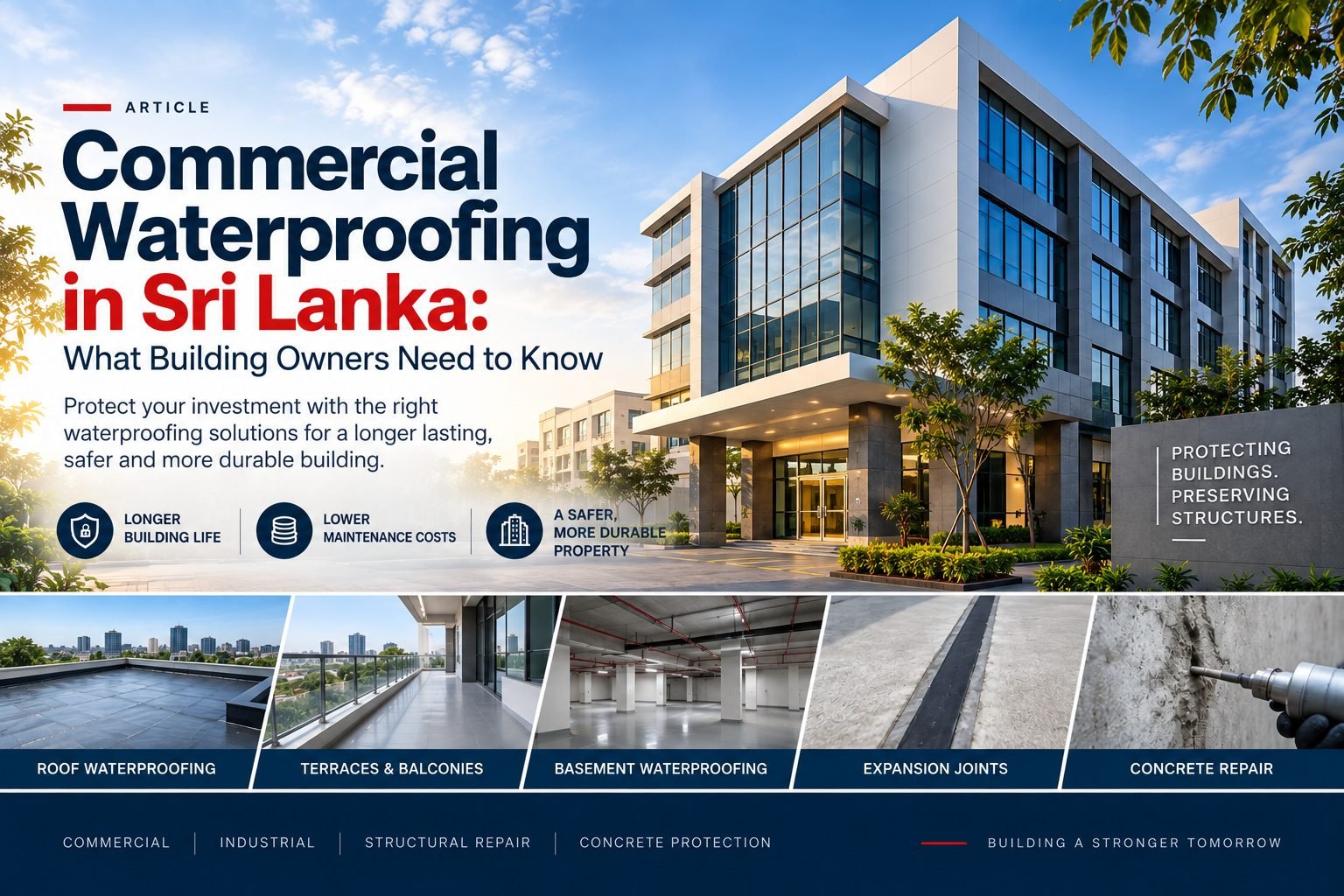
Commercial building owners in Sri Lanka face a specific set of challenges when it comes to waterproofing. The scale is larger, the consequences of failure are higher, and the systems required are more demanding than those used in residential buildings. A leak in a single apartment is inconvenient. A leak in a commercial building can disrupt multiple tenants, trigger liability claims, damage expensive equipment, and affect the asset value of the entire property.
This guide covers what every commercial building owner in Sri Lanka needs to understand about waterproofing — what needs to be done, when, which systems work, and how much it costs.
Why Commercial Buildings Need a Different Approach
Residential waterproofing and commercial waterproofing are not the same exercise. Commercial buildings present challenges that simply do not exist at residential scale:
- Larger surface areas — a commercial building may have thousands of square feet of roof, podium deck, basement and facade to protect. Small defects in application at this scale translate to large areas of failure.
- More complex geometry — commercial buildings have more penetrations (pipes, conduits, drainage outlets, mechanical equipment), more joints, more changes in level, and more interfaces between different materials. Each one is a potential water entry point.
- Multiple stakeholders — a leak in a commercial building can affect dozens of tenants, building management, the developer, and in some cases government bodies. The liability implications are significant.
- Higher expectations — a luxury apartment building, a hotel, a hospital or a government facility has a much lower tolerance for water ingress complaints than a basic residential property.
- Occupied buildings — most commercial waterproofing work has to be done while the building is in use, requiring careful planning to minimise disruption.
💡 The key principle: In commercial waterproofing, the cost of getting it wrong is proportional to the building's value and the number of occupants affected. This is why certified systems with written warranties are non-negotiable for commercial projects.
The Five Areas That Need Waterproofing in Every Commercial Building
1. Roof Waterproofing
The roof is where most commercial building waterproofing failures begin. In Sri Lanka, the combination of intense monsoon rainfall and high UV exposure creates an extremely demanding environment for roof waterproofing systems.
Flat concrete roofs — which are standard on virtually all commercial buildings in Sri Lanka — collect water rather than shedding it like pitched roofs. They rely entirely on drainage outlets to remove rainfall. When drainage fails or becomes blocked, water ponds. Ponding water creates sustained hydrostatic pressure that exploits every weakness in the waterproofing system below.
What Can Go Wrong
- No waterproofing system at all — more common than it should be in older commercial buildings
- Failed or degraded waterproofing membrane from UV exposure and thermal cycling
- Blocked roof drains causing ponding
- Failed seals at pipe penetrations and roof edge details
- Cracked screed or topping over the waterproofing membrane
Correct Systems for Commercial Roofs
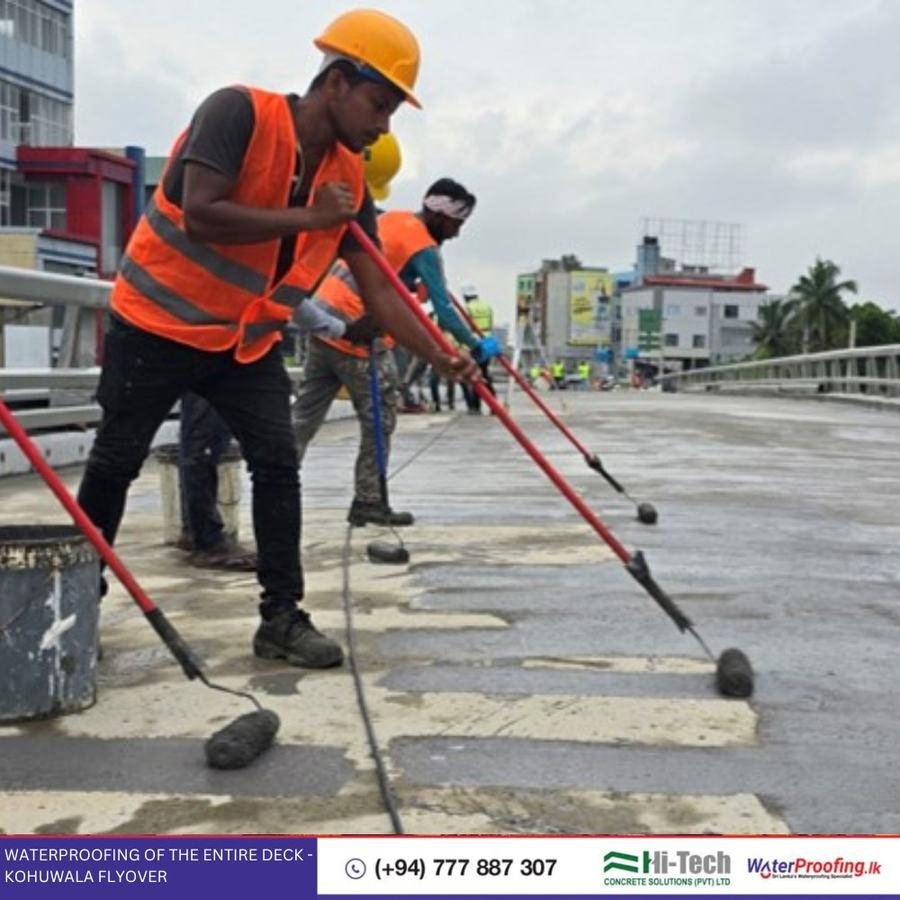
For exposed commercial roofs in Sri Lanka, Supercrete Duraproof PU 550 is the premium specification — a seamless polyurethane liquid membrane with excellent UV stability and weathering resistance. For roofs under screed, paving or green roof build-ups, Supercrete Duraflex Ultra or Duraflex 100 are the standard systems.
2. Terraces and Balconies
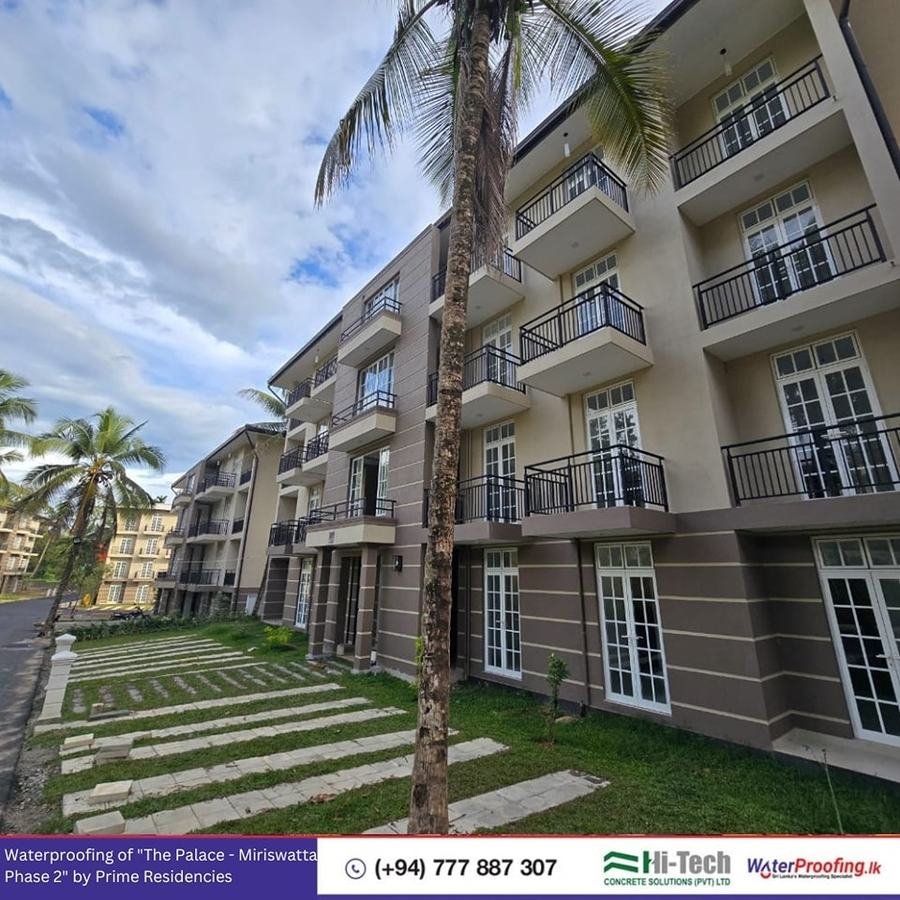
Terraces and balconies in commercial buildings are a specific waterproofing challenge. They are exposed to full UV and weather, they are trafficked by people, and they move — both from thermal expansion and contraction and from structural loading.
A waterproofing system for a terrace or balcony must be flexible — it must be able to bridge hairline cracks that form as the structure moves. A rigid system applied to a moving surface will crack along with the structure, and once it cracks, it is no longer waterproof.
Key Requirements
- Flexibility — the membrane must elongate without cracking. Supercrete Duraflex Ultra has titanium modification that provides exceptional elongation.
- UV resistance — for exposed terraces, the system must not degrade under direct sunlight. PU systems have better UV resistance than standard cementitious membranes.
- Trafficability — if people will walk on the surface, a protection layer over the waterproofing membrane is required before paving or tiles are laid.
- Edge details — the junction between the terrace waterproofing and the building facade is a critical detail. Water that gets behind the junction will enter the structure.
3. Basement Waterproofing
Basements in commercial buildings in Sri Lanka face sustained hydrostatic water pressure from surrounding soil and groundwater. This is fundamentally different from roof waterproofing — instead of managing rainfall, you are managing water that is permanently present and pushing against your structure from outside.
The correct system for basement waterproofing depends on when in the construction programme it is applied. During construction, the external face of the basement wall is accessible — waterproofing can be applied to the positive side (the side where water is pressing from). After construction, only the internal face is accessible — negative side waterproofing.
Construction-Stage vs Remedial
Positive-side (external) basement waterproofing, applied during construction, is always more effective than negative-side (internal) remedial treatment. However, crystalline systems like Supercrete Duraseal XP are one of the few technologies that can be applied effectively from the negative side — they penetrate into the concrete and form crystals that block water pathways from within, regardless of which face they are applied to.
For new commercial developments, the correct specification combines crystalline waterproofing on construction joints and structural elements with a flexible membrane on the external face of basement walls and the underslab.
4. Expansion Joints
Expansion joints are designed into commercial buildings to accommodate thermal and structural movement. They are also one of the most common sources of water ingress. The joint sealant — usually a polyurethane or polysulphide sealant — is designed to accommodate movement while maintaining a waterproof seal. When the sealant ages, hardens, debonds or is damaged, water enters.
The challenge with expansion joints is that they move. Standard waterproofing membranes cannot bridge a moving joint — the membrane will tear. Joint waterproofing requires specialist products — pre-formed joint seals, bond-breaker backed sealants, or PU injection — that can accommodate ongoing movement.
⚠️ Maintenance note: Expansion joint sealants should be inspected annually in commercial buildings. Sealant replacement on a 10–15 year cycle is normal maintenance. Delaying sealant replacement to avoid cost is consistently one of the most expensive decisions building managers make — water ingress through failed joints causes disproportionate structural damage relative to the small area of the joint itself.
5. Concrete Repair and Protective Coatings
Commercial buildings develop concrete defects over time — carbonation, spalling, rebar corrosion, crack development, surface erosion. These defects must be correctly repaired before any waterproofing system is applied. Applying waterproofing over damaged concrete is one of the most common reasons why commercial waterproofing jobs fail prematurely.
The sequence is always: assess substrate → repair damage → treat reinforcement if exposed → apply primer → apply waterproofing system. Skipping any of these steps reduces the lifespan and effectiveness of the waterproofing applied.
Which Waterproofing Systems Are Used for Commercial Buildings
The choice of waterproofing system for a commercial building depends on the specific area being treated, the substrate condition, the performance requirement and the exposure. In practice, most large commercial buildings use multiple systems — each area gets the specification suited to its conditions.
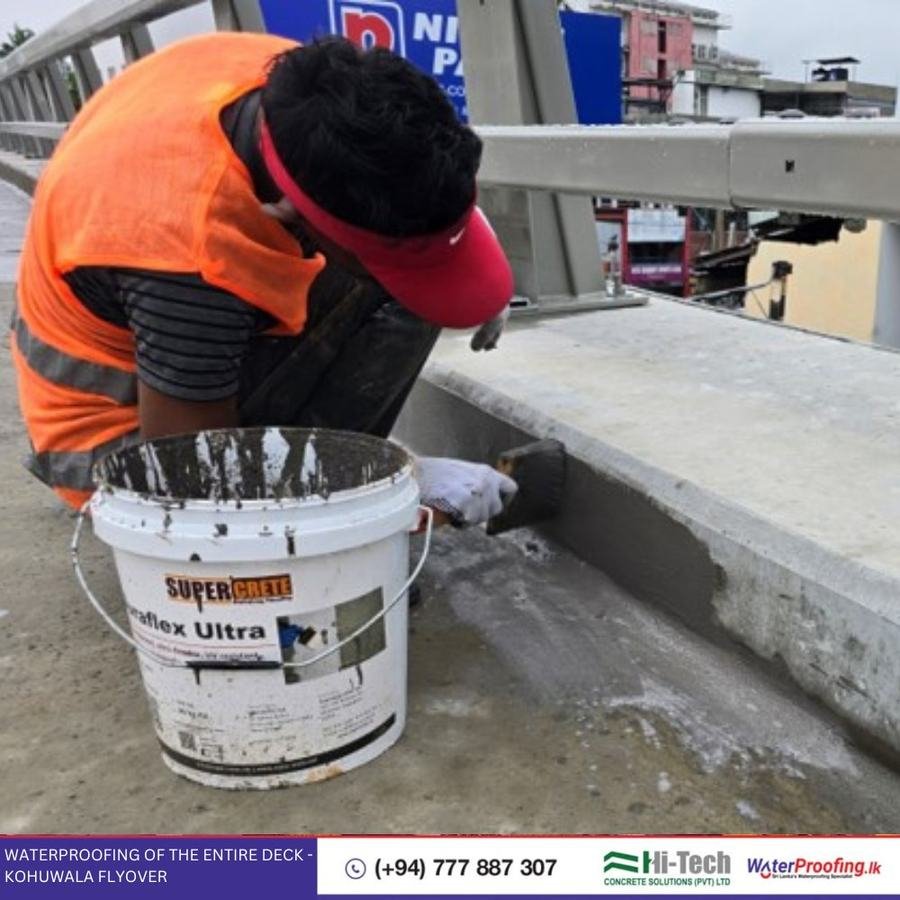
- Supercrete Duraflex Ultra — flexible 2-component cementitious slurry. Award-winning at Architect 2025. Used for roofs, wet areas, balconies, podium slabs. Excellent elongation, bonds to concrete and masonry.
- Supercrete Duraflex 100 — 2-component highly flexible cementitious system. 100% elongation. Used for exposed roofs, terraces and areas requiring maximum flexibility.
- Supercrete Duraseal XP — crystalline waterproofing. Self-healing, penetrates concrete. Used for basements, structural elements, water tanks and construction joints.
- Supercrete Duraproof PU 550 — polyurethane liquid membrane. Seamless, UV-stable, highly flexible. Used for exposed roofs, bridge decks and podium car park decks.
- Supercrete Duraproof AC 300 — elastic acrylic coating. UV cross-linking, breathable. Used for facades and wall waterproofing.
- PU Crack Injection — for active cracks and leaking joints in existing structures. Stops water immediately, even in the presence of flowing water.
Cost Guide for Commercial Waterproofing in Sri Lanka
| Area / Application | System | Cost Range |
|---|---|---|
| Roof slab (under screed/paving) | Duraflex Ultra or Duraflex 100 | Rs. 400–550/sqft |
| Exposed roof (no topping) | Duraproof PU 550 | Rs. 500–650/sqft |
| Terrace / balcony | Duraflex Ultra (flexible) | Rs. 450–600/sqft |
| Basement (new construction) | Duraseal XP + membrane | Rs. 600–800/sqft |
| Basement (remedial, negative side) | Duraseal XP crystalline | Rs. 650–850/sqft |
| Expansion joint sealant | PU joint sealant | Rs. 800–2,000/m |
| PU crack injection | PU injection | Rs. 800–1,500/m |
| Facade / wall coating | Duraproof AC 300 | Rs. 300–450/sqft |
| Concrete repair + protective coat | Repair mortar + coating | Project-specific |
📜 These are indicative costs for certified professional application with a 10-year written warranty. Actual cost depends on substrate condition, access, area size and system specification. Contact us for a free site inspection and written quotation.
How to Choose the Right Commercial Waterproofing Contractor
For a commercial building, choosing the wrong waterproofing contractor is a significant risk. A failed waterproofing system on a commercial building is expensive to remediate, disruptive to occupants, and can create liability for the building owner.
These are the criteria that matter for a commercial project:
- Manufacturer certification — the contractor must be certified by the product manufacturer. WaterProofing.lk (Hi-Tech Concrete Solutions) is the only authorised Supercrete New Zealand applicator in Sri Lanka. Applying a Supercrete system without certification voids the manufacturer warranty.
- Track record on commercial projects — ask for a list of completed commercial projects similar to yours. A contractor who has only done residential work is not equipped for a large commercial job. Our project portfolio includes government hospitals, luxury towers, national infrastructure and commercial complexes.
- Written warranty — a reputable commercial waterproofing contractor provides a minimum 10-year written warranty covering both materials and workmanship. Verbal warranties are not enforceable.
- System specification in writing — before work begins, you should receive a written document specifying exactly which system will be applied, the application method, the number of coats, the coverage rate, and the curing time.
- Site assessment first — a good contractor will inspect your building before providing a price. A contractor who quotes without seeing the substrate cannot give you an accurate price or specification.
Frequently Asked Questions
Protect Your Commercial Building Investment
Free site inspection for commercial buildings island-wide. Our certified specialists will assess every waterproofing area, specify the right system, and provide a written quotation and warranty.