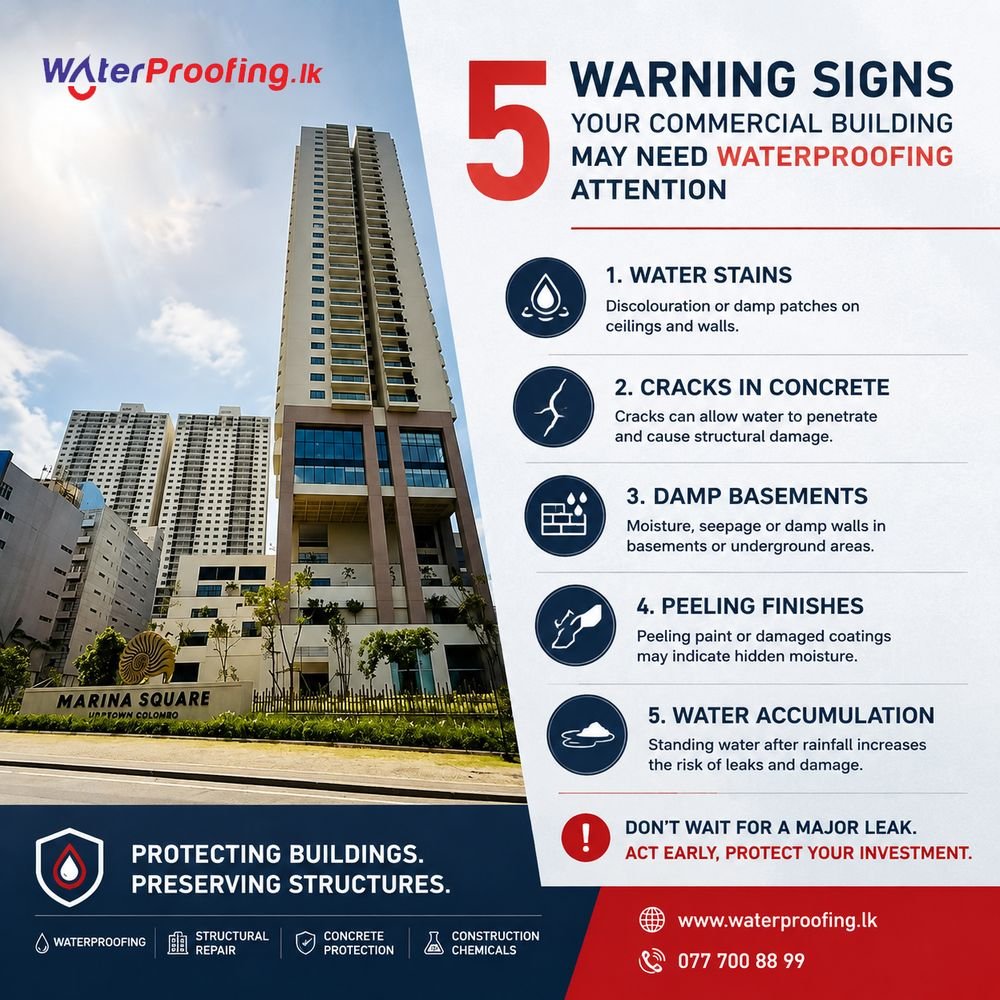
- Why early detection saves money
- Sign 1 — Water stains on ceilings and walls
- Sign 2 — Cracks in concrete
- Sign 3 — Damp basements and underground areas
- Sign 4 — Peeling paint and damaged finishes
- Sign 5 — Water accumulation after rainfall
- What to do when you spot these signs
- Real commercial buildings in Sri Lanka
- Frequently asked questions
Most water damage in commercial buildings does not happen suddenly. It builds up quietly over weeks and months. By the time there is visible leaking, water has already been working its way through the structure for some time.
The good news is that water damage almost always gives you warning before it becomes serious. Knowing what to look for — and acting on it — is the difference between a straightforward waterproofing job and a major structural repair bill.
This article is written for commercial building owners, property managers, facilities managers and developers in Sri Lanka. If you manage or own a commercial building, these are the five things you need to be checking regularly.
Why Early Detection Saves Money
The relationship between water damage and cost is not linear. A small leak caught early costs very little to fix. The same leak ignored for one or two monsoon seasons can require tens of times more to remediate.
Here is the rough cost progression for a typical roof slab waterproofing failure in a commercial building in Sri Lanka:
- Early stage — surface treatment only: Rs. 400–600/sqft
- Mid stage — surface repair + waterproofing: Rs. 800–1,200/sqft
- Late stage — structural repair + waterproofing + ceiling reinstatement: Rs. 2,500–5,000/sqft
- Severe damage — structural element replacement: Project-specific, often exceeds construction cost
That cost escalation happens because water does not stay where it enters. It migrates through the structure, reaches reinforcement steel, causes corrosion, creates spalling, and degrades the concrete itself. Every month of delay increases the remediation scope.
💡 The rule of thumb: For every Rs. 1 spent on proactive waterproofing, you avoid Rs. 5–10 in future remediation costs. This is why commercial building maintenance budgets should always include a waterproofing inspection line.
Sign 1 — Water Stains on Ceilings and Walls
Water Stains
Discolouration or damp patches on ceilings and walls — brown rings, yellow patches, tide marks or general darkening of ceiling boards and painted surfaces.
Water stains are the most visible sign of water ingress. What most building managers don't realise is that by the time a stain appears on a ceiling, water has already passed through the concrete slab, through any screed or insulation, through ceiling boards or plaster, and dried out enough to leave a deposit.
The stain is not where the problem is. The problem is usually one or two floors above — at the slab surface, at a joint, at a pipe penetration, or at a drainage outlet that has failed. Looking only at the stain tells you nothing about the source.
What You Should Do
Do not just repaint over a water stain. It will come back. The water source needs to be identified and treated. In a commercial building this typically means a roof inspection after rainfall, checking drainage outlets, inspecting pipe penetrations, and in some cases a water test of the floor or slab above the affected area.
⚠️ Common mistake: Many building managers apply waterproof paint to the underside of a stained ceiling. This treats the symptom, not the cause. The water continues to enter from above, builds up, and eventually forces its way through the repair — often in a different location.
Sign 2 — Cracks in Concrete
Cracks in Concrete
Visible cracks in concrete slabs, columns, beams, walls or facades. These can allow water to penetrate and reach reinforcement steel, causing progressive structural damage.
Not all cracks are equal, but all cracks in concrete warrant attention when it comes to waterproofing. Even a hairline crack — one that appears too small to matter — can allow water to enter under hydrostatic pressure during heavy rainfall.
Sri Lanka's monsoon conditions create exactly the kind of sustained rain that drives water into small cracks under pressure. A crack that is perfectly dry in January can be actively leaking in May when the southwest monsoon hits.
Types of Cracks to Watch For
- Hairline cracks (less than 0.2mm wide) — Monitor. Can be treated with crystalline coatings like Supercrete Duraseal XP which penetrate and seal without surface treatment.
- Fine cracks (0.2mm–0.5mm) — Treat. These can bridge with a flexible cementitious system. Apply during dry season before monsoon.
- Wide cracks (over 0.5mm) — Structural inspection required. PU crack injection or epoxy injection followed by waterproofing is the standard approach.
- Active cracks (moving, wet) — Urgent. PU injection can seal active leaks immediately, even in the presence of water. This is the first step before any other treatment.
🚨 Never ignore rust stains near a crack. Orange or brown staining around a crack means water has reached the reinforcement steel and corrosion has already started. At this stage, structural assessment is required before waterproofing.
Sign 3 — Damp Basements and Underground Areas
Damp Basements
Moisture, seepage or damp walls in basements, car parks or any underground areas. Soil moisture and groundwater create constant hydrostatic pressure against basement walls and floors.
Basements in Sri Lanka face a specific challenge. The water table in many parts of the island — particularly near rivers, coastal areas and in Colombo — is relatively high. Add to this the soil saturation that comes with monsoon rainfall, and basement structures are under significant and sustained hydrostatic water pressure.
Symptoms of basement water ingress include damp patches on walls, efflorescence (white salt deposits on concrete surfaces), musty odour, and in more serious cases, actual seeping or dripping water.
Why Basements Are Harder to Fix After the Fact
Basement waterproofing is one area where the difference between construction-stage application and remedial treatment is most significant. During construction, waterproofing membranes are applied to the external face of the basement wall before backfilling — where they can be inspected, tested, and properly lapped. After construction, the external face is buried and inaccessible. All remedial work must be done from the inside (negative side), which is inherently less effective.
This is why crystalline systems like Supercrete Duraseal XP are particularly valuable for remedial basement work — they can be applied to the internal face and still penetrate into the concrete to block water pathways from within. But the best time to waterproof a basement is always during construction.
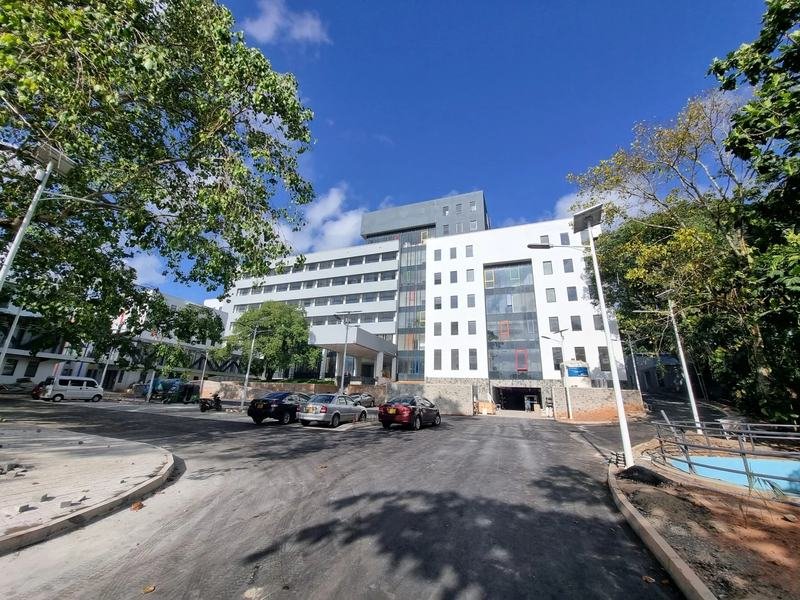
Sign 4 — Peeling Paint and Damaged Finishes
Peeling Finishes
Peeling paint, bubbling coatings, delaminating tiles or damaged plaster on walls and ceilings. These are almost always caused by moisture behind the finish, not by the finish itself failing.
When paint peels, the instinct is to blame the paint. In a commercial building, paint rarely fails on its own — it fails because moisture is coming from behind it and breaking the bond between the paint and the substrate.
In Sri Lanka's climate, this is common on external walls exposed to driving rain, on bathroom walls in commercial buildings, and on ground-floor walls that have rising damp from the slab or floor. The fix is not repainting. The fix is identifying and treating the moisture source, then repainting.
What Peeling Tells You
- Peeling on external walls — likely facade water ingress or failed joint sealant. Needs facade inspection and possible protective coating application.
- Peeling on ceilings — water is coming from above. Same as water stains — the source is upstairs, not in the ceiling itself.
- Bubbling tiles in wet areas — classic failure of under-tile waterproofing membrane. Water is entering through grout joints or tile edges and accumulating beneath the tile.
- Delaminating plaster — sustained moisture has broken down the bond. The plaster and any finish on it will need to be removed before the substrate can be treated.
Sign 5 — Water Accumulation After Rainfall
Water Accumulation
Standing water or ponding on flat roofs, terraces, podium decks or car parks after rainfall. Water that does not drain freely creates sustained hydrostatic pressure on the waterproofing membrane below.
Flat roofs and podium decks are designed to drain. When water accumulates after rain, it means either the drainage system has failed or was never adequate, or the slab has settled unevenly over time creating low points. Either way, standing water is a serious risk.
Ponding water creates sustained hydrostatic pressure that pushes down on the waterproofing system below. Most waterproofing systems are designed for rainfall exposure — water that falls, runs off and drains. Sustained ponding is a completely different load case. It exploits every pinhole, joint and defect in the membrane, and eventually forces water through.
The Specific Risk in Sri Lanka
During the southwest monsoon, sustained heavy rainfall can create ponding conditions on flat roofs for hours or days at a time. A roof that looks fine during light rain may start leaking under extended monsoon downpours because the ponding pressure finally overcomes a weakened section of the waterproofing.
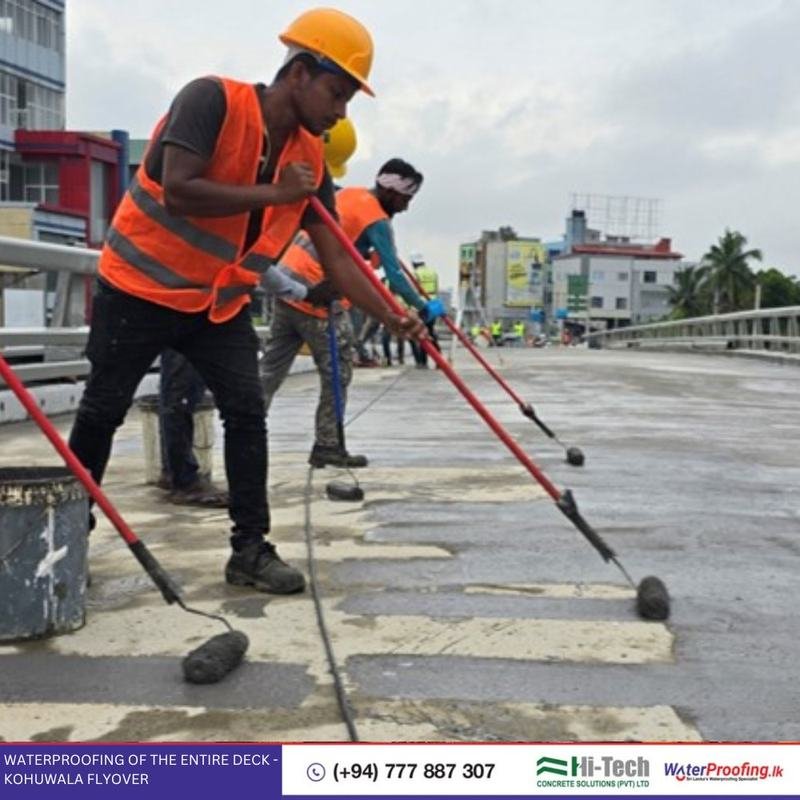
If you see ponding on your commercial building roof after rain, two things need to happen: the drainage needs to be improved or restored, and the waterproofing system needs to be assessed for damage caused by previous ponding episodes.
What to Do When You Spot These Signs
The most important thing is not to delay. Water damage that would have been a Rs. 500,000 fix in March becomes a Rs. 3,000,000 fix by December if left through the monsoon season.
Here is the correct sequence:
- Document what you see — photograph stains, cracks, damp areas. Note when they appeared and whether they correlate with rainfall. This information is useful for the waterproofing specialist.
- Get a professional site inspection — not a quotation, an inspection. A good waterproofing specialist will identify the source, not just the symptom. WaterProofing.lk provides free site inspections for commercial buildings island-wide.
- Get a written system recommendation — the specialist should specify exactly which system they will use, why, and what warranty they provide. Do not accept verbal commitments.
- Act before the next monsoon — if you are between monsoon seasons, use that window. Waterproofing cannot be applied to wet substrates and works best when the structure has had time to dry.
- Verify the contractor is certified — ensure the applicator is certified by the product manufacturer. Hi-Tech Concrete Solutions (WaterProofing.lk) is the only authorised Supercrete New Zealand applicator in Sri Lanka, with 10-year written warranty on all certified applications.
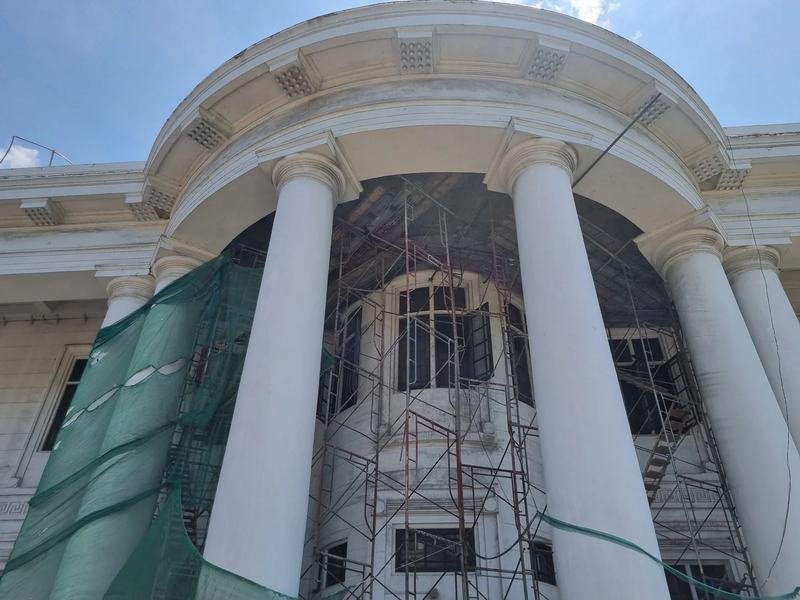
Real Commercial Buildings in Sri Lanka — What We Found
Across 500+ projects island-wide, these are the most common findings when we do site inspections on commercial buildings that owners thought "were fine":
- Rooftop drains blocked by debris — creating ponding over large areas of the roof. Often the building has had water ingress complaints for months before anyone checked the drainage outlets.
- No waterproofing under bathroom tiles on upper floors — this is particularly common in older commercial buildings and hotels. Water seeps through grout joints into the screed, accumulates, and eventually leaks through to the ceiling below. Often discovered only when the ceiling below is already damaged.
- Sealant failure at expansion joints — expansion joints in commercial buildings are designed to accommodate structural movement. If the sealant fails, water enters at these high-risk points on every floor. This is a straightforward fix but is very commonly missed during routine maintenance.
- No waterproofing on podium decks — many commercial buildings with above-ground car parks or podium gardens have no proper waterproofing on the podium slab. Water leaks into the car park ceiling below, and in some cases reaches structural elements below the podium.
- Crack injection deferred year after year — structural cracks that first appeared as hairlines and were noted in maintenance reports but never treated. By the time they are brought to us, they are wide, active, and accompanied by significant rebar corrosion.
None of these are unusual. All of them are avoidable with regular inspection and timely action.
Frequently Asked Questions
See Any of These Signs in Your Building?
Don't wait for a major leak. Our certified specialists provide free commercial site inspections — island-wide. Get a written system recommendation and quotation at no cost.