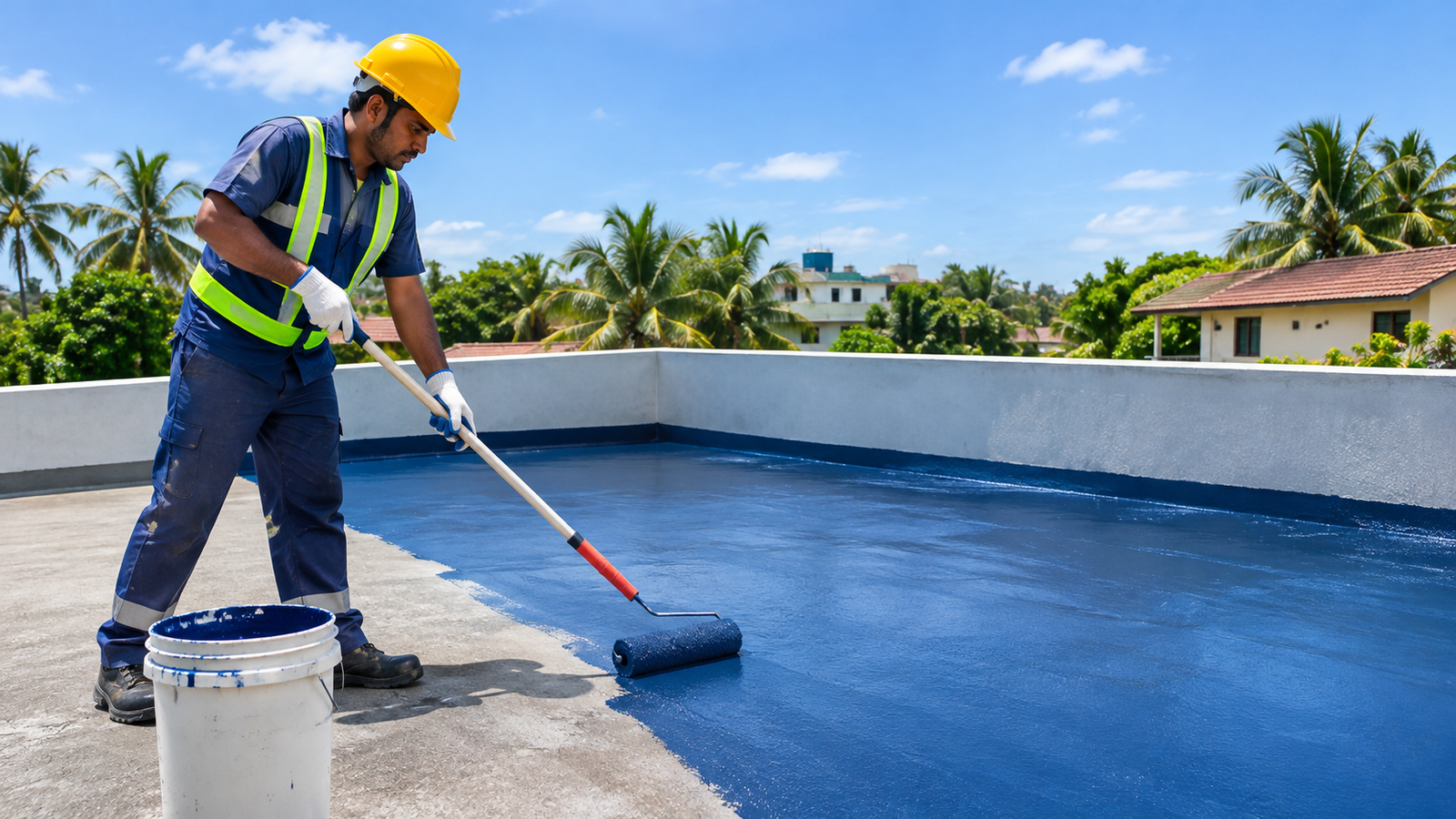
A leaking roof is one of the most common and costly building problems in Sri Lanka. With two monsoon seasons delivering heavy rainfall across the island every year, a failed or missing roof waterproofing system will eventually let water through — damaging ceilings, walls, electrical systems and the structure itself. This guide explains the real causes of roof leaks, the warning signs to watch for, and how professional waterproofing permanently stops them.
Whether you have a flat concrete roof, a tiled roof or a large commercial slab, understanding what causes roof leaks — and what actually fixes them — can save you thousands of rupees in repair costs and protect your property for years to come.
Why Do Roofs Leak in Sri Lanka?
Sri Lanka's tropical climate is tough on buildings. The South-West monsoon (May–September) and North-East monsoon (October–January) bring sustained heavy rainfall that exposes every weakness in a roof. Add year-round heat, UV radiation and humidity, and the conditions that cause roof leaks become clear.
Most roof leaks in Sri Lanka are not caused by a single dramatic failure — they develop gradually as a result of one or more of the following:
Common Causes of Roof Leaks in Sri Lanka
- No waterproofing membrane: Many older concrete roofs in Sri Lanka were never waterproofed. Bare concrete is porous — water penetrates it slowly, eventually appearing as stains or drips on the ceiling below.
- Failed or degraded waterproofing: Bituminous paint, cementitious coatings and cheap sealants deteriorate within 2–5 years under UV exposure and thermal cycling. Once they crack or peel, they offer no protection.
- Structural cracks in the slab: Concrete expands and contracts with temperature changes. Without a flexible waterproofing membrane, fine cracks develop and widen — letting water in every monsoon.
- Ponding water (poor drainage): Flat roofs with blocked or inadequate drainage hold rainwater for hours or days. Standing water finds any crack or joint and forces its way through.
- Parapet wall failures: Where the flat roof meets the parapet wall, water collects and seeps through poorly sealed junctions — one of the most common leak points in Sri Lankan homes.
- Failed expansion joints: Joints between concrete sections are designed to allow movement. When their sealant deteriorates, they become direct paths for water entry.
- Roof penetrations: Pipes, cables, AC brackets and other penetrations through the slab are common leak points if not properly waterproofed and sealed.
- Poor original construction: Inadequate concrete mix, insufficient cover over reinforcement and poor compaction create a porous, weak slab that leaks from the start.
Warning Signs Your Roof Needs Waterproofing
Roof leaks rarely appear without warning. These are the signs that indicate your roof waterproofing system is failing or absent — and that action is needed before the next monsoon causes serious damage.
⚠ Do Not Ignore These Warning Signs
- Water stains or damp patches on ceilings or upper walls — especially after heavy rain
- Peeling paint or bubbling plaster on ceilings and internal walls below the roof
- Visible cracks in the concrete roof slab or parapet walls
- Moss, algae or dark staining on the roof surface — indicates persistent moisture retention
- Rust-coloured stains on the ceiling (sign of corroding reinforcement inside the slab)
- Standing water on the roof after rain (ponding)
- Musty smell inside top-floor rooms — hidden moisture in the slab or ceiling void
- Existing waterproofing coating that is cracked, peeling or hollow-sounding when tapped
If you can see any of these signs, the problem is already progressing. Every monsoon without waterproofing allows more water into the slab — accelerating concrete carbonation, corroding reinforcement and weakening the structure. Early action is always less expensive than delayed repairs.
Temporary Fix vs Permanent Solution
Many property owners in Sri Lanka try to solve roof leaks with quick-fix products — bitumen tape, water-cement paint, cementitious putty or silicone sealant. These products have a role in minor maintenance, but they are not a substitute for a proper waterproofing system.
| Approach | How Long It Lasts | Addresses Root Cause? | Cost |
|---|---|---|---|
| Bitumen paint / coating | 2–4 years | No | Low |
| Silicone sealant on cracks | 1–2 monsoons | No | Very Low |
| Cementitious waterproof paint | 2–3 years | No | Low |
| Professional flexible membrane system | 10–15+ years | Yes | Medium |
| Certified waterproofing (with warranty) | 10 years written warranty | Yes | Medium |
The key difference: temporary patches cover the symptom. A professional waterproofing system treats the slab surface, bridges existing cracks, corrects drainage and creates a continuous sealed membrane — stopping water entry at the source rather than masking it.
How Professional Roof Waterproofing Works
A properly executed roof waterproofing job follows a structured process. Skipping any step — especially surface preparation — is the most common reason waterproofing systems fail prematurely.
Free On-Site Inspection
A certified waterproofing technician inspects the roof to identify the source of water entry, assess the slab condition, check drainage, map existing cracks and document the full scope of work needed. This is provided free of charge with a written quote.
Surface Preparation
The existing surface is cleaned, failed coatings are removed, loose material is ground back and the slab is prepared to a sound substrate. This is the most critical step — no waterproofing system performs correctly on a contaminated or weak surface.
Crack Repair & Joint Treatment
Structural cracks are repaired and treated before the main waterproofing membrane is applied. Expansion joints and parapet-wall junctions are addressed with appropriate flexible sealants to prevent movement-related failure.
Waterproofing Membrane Application
A certified two-component flexible cementitious slurry (such as Duraflex 100 or Duraflex Ultra) is applied in a minimum of two coats to the specified consumption rate. The system bonds directly to concrete, provides Class A4 crack-bridging and is UV resistant.
Curing & Quality Check
Each coat is allowed to cure fully before the next is applied. After completion, the membrane is inspected and a water retention test may be conducted to verify continuity before the job is signed off.
Written 10-Year Warranty Issued
Once the work is complete and inspected, a written 10-year warranty is issued. Any defects within the warranty period are addressed at no additional cost.
Best Waterproofing Products for Roofs in Sri Lanka
The waterproofing product market in Sri Lanka includes a wide range of systems — from low-cost bituminous coatings to certified high-performance membranes. For flat concrete roofs, two-component flexible cementitious slurry systems have consistently proven to be the most reliable choice in Sri Lanka's climate.
Duraflex 100 — Flexible Cementitious Waterproofing
Duraflex 100 by Supercrete New Zealand is a certified two-component polymer-modified cementitious slurry. It provides 101.2% elongation at break and Class A4 crack-bridging — meaning it bridges cracks wider than 1.25mm without membrane failure. It is UV-resistant, suitable for potable water tanks and swimming pools, and bonds directly to concrete without a primer on most substrates.
Duraflex Ultra — Premium High-Performance Membrane
Duraflex Ultra is the advanced version of the Duraflex range — designed for more demanding structural conditions, higher water pressure, exposed rooftops and projects where the highest level of certified performance is required. Both systems are certified to EN 14891, EN 1504-2 and ISO 9001.
Why These Systems Work in Sri Lanka
- Direct bond to concrete — no slippage layer, no debonding risk
- Flexible membrane bridges thermal cracks without failure
- UV stable — no protective screed required on most applications
- Breathable — allows residual moisture in the slab to escape without blistering
- Certified by DNV-GL ISO 9001, EN 14891 and EN 1504-2
- Suitable for Sri Lanka's tropical conditions — high humidity, UV and thermal cycling
- Applied by certified trained applicators with written warranty

DIY vs Professional Waterproofing
It is possible to apply waterproofing products yourself, and for small, accessible areas with minor issues, a DIY approach using quality materials can help. However, for a leaking concrete roof — which involves assessing the full slab condition, treating cracks, correcting drainage and applying a certified membrane — professional application is strongly recommended for the following reasons:
- Diagnosis: Correctly identifying the source of water entry requires experience. What appears as a ceiling stain directly below the leak point often originates from a different location on the roof.
- Surface preparation: Inadequate surface prep is the leading cause of waterproofing failure. Professional applicators use the correct tools and processes to achieve the required surface profile.
- Correct consumption: Applying waterproofing at the wrong thickness or consumption rate — even with a good product — results in an under-performing membrane.
- Warranty: Manufacturer and applicator warranties are only valid when the product is applied by a certified applicator. A DIY application carries no warranty protection.
- Drainage correction: Many roof leaks are partly or entirely caused by drainage problems. Professional assessment identifies this — a DIY product application will not correct it.
Roof Leaking? Get a Free Inspection
Our certified waterproofing technicians will assess your roof, identify the source of the leak and provide a written quote — at no cost and no obligation. 10-year written warranty on all work.
How Much Does Roof Waterproofing Cost in Sri Lanka?
The cost of professional roof waterproofing in Sri Lanka varies depending on several factors:
- Roof area: Larger areas reduce the per-square-foot cost.
- Slab condition: Heavily cracked or damaged slabs require more preparatory work before waterproofing can be applied.
- System selected: A standard cementitious membrane costs less than a high-performance system like Duraflex Ultra. The right system depends on your water exposure level.
- Drainage corrections: If the roof has inadequate or blocked drainage, correcting this adds cost but is essential for long-term performance.
- Access: High-rise buildings or difficult-access roofs may require additional safety equipment and time.
As a general guide, professional roof waterproofing in Sri Lanka typically starts from around Rs. 350–550 per sq ft for standard residential applications using certified flexible cementitious systems. For an accurate cost, the only reliable approach is a free on-site inspection and written quote — which we provide at no charge.
Roof Waterproofing Across Sri Lanka
WaterProofing.lk — Hi-Tech Concrete Solutions (Pvt) Ltd — provides professional roof waterproofing services across the island. Our certified teams work in:
- Colombo and Western Province — the most densely populated region, with a mix of residential apartments, commercial buildings and industrial facilities all requiring specialist roof waterproofing.
- Kandy and Central Province — the highland climate brings some of the highest rainfall in Sri Lanka. Flat roofs in Kandy face greater water load and need robust flexible systems.
- Galle, Kalutara and Negombo — coastal salt air accelerates concrete degradation. Roof waterproofing in these areas requires UV-resistant, salt-tolerant membrane systems.
We also serve Matara, Hambantota, Kurunegala, Anuradhapura, Trincomalee and other areas across Sri Lanka — call us to confirm coverage for your location.
